


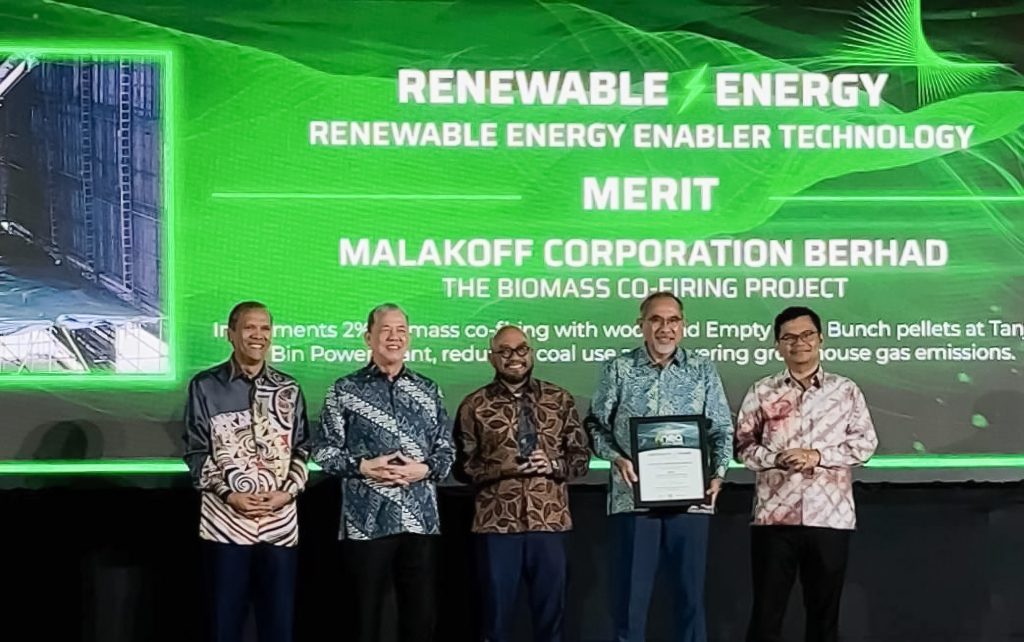
MALAKOFF Corporation Berhad (Malakoff) has received a Merit Award at the National Energy Awards (NEA) 2025 for its Biomass Co-firing Project at the Tanjung Bin Power Plant (TBPP) in Johor.
The recognition was presented at a ceremony officiated by Deputy Prime Minister and Energy Transition and Water Transformation Minister Datuk Seri Fadillah Yusof, which celebrated Malaysia’s outstanding achievements in renewable energy, energy efficiency and innovation.
The Merit Award highlights Malakoff’s pioneering role in Malaysia’s clean energy transition. In May 2024, Malakoff successfully launched its Biomass Co-firing Project, a key component of the National Energy Transition Roadmap (NETR), by introducing sustainably sourced biomass into the coal-fired boilers of its 2,100 MW TBPP.
The pilot phase, which began with a modest 2% biomass mix using wood and later Empty Fruit Bunch (EFB) pellets, has already shown promising results in reducing greenhouse gas emissions while showing that biomass can be a practical and affordable way to support Malaysia’s energy transition.
Biomass co-firing brings significant environmental benefits because it is widely considered carbon-neutral, where the carbon released during combustion is roughly balanced by the carbon absorbed during plant growth. Even at the pilot stage, Malakoff’s initiative has reduced carbon dioxide emissions by an estimated 755,000 tons a year.
If implemented at a larger scale, biomass co-firing has the potential to reduce emissions by millions of tons annually, which is comparable to planting more than 47 million mature trees, removing over 449,000 cars from the road or protecting 2.26 million acres of forest.
Beyond reducing emissions, the project also helps manage agricultural waste. Malaysia’s palm oil industry produces a large amount of by-products such as EFB, which if left to decompose release methane, a greenhouse gas far more harmful than carbon dioxide.
By converting this waste into fuel, Malakoff is not only cutting these emissions but also creating new income opportunities for local suppliers. In the longer term, greater adoption of biomass in the power sector can help build a local industry that could also supply to or for power plants abroad.
This would make better use of Malaysia’s abundant agricultural waste while reducing the country’s reliance on imported fuels such as coal and, in the future, Liquefied Natural Gas (LNG).
Group CEO Syahrunizam Samsudin noted that the Merit Award is an important milestone for Malakoff and a meaningful acknowledgement of its efforts to accelerate Malaysia’s energy transition.
“Our Biomass Co-firing Project is proof that environmental responsibility and energy security can move forward together. By using agricultural waste as a renewable fuel, we are reducing emissions, creating new opportunities for local communities and supporting Malaysia’s ambition for a just and sustainable energy future.
“As we celebrate Malakoff’s 50th anniversary this year, this recognition strengthens our resolve to power progress for generations to come,” he said in a statement.
This recognition at the NEA 2025 reaffirms Malakoff’s leadership in advancing sustainable energy solutions.
Building on its track record of innovation and industry recognition, Malakoff remains committed to its purpose of ‘Enhancing Life, Enriching Communities’ and to powering a cleaner and more resilient energy future for Malaysia. — TMR
Source: The Malaysian Reserve